
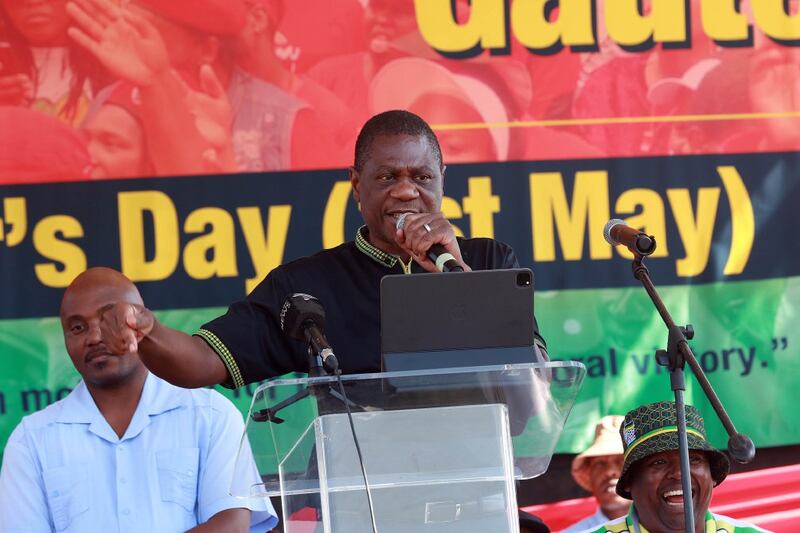
The tripartite alliance of the ANC, SACP and Cosatu is in a state of uncertainty. Before the May 2024 elections its unity was already in crisis, and its fragility necessitated reconfiguration. But it had to endure to safeguard the democratic gains accrued after April 1994.
Unfortunately the outcome of the GNU negotiations caused the SACP to decide to contest the 2026 local elections independently, generating existential risk-to-all tension within the alliance.
Its impact will be to separate diehard SACP members from the ANC. In a relationship where the prize is state power, political parties without a pre-election pact only fraternise after proven electoral support to establish governing coalition arrangements. The SACP-ANC relationship has reached that point. The discord on fundamental economic policy positions between the two parties has erected more walls than bridges.
The ANC has become the most suitable candidate for a coalition partner for all political persuasions in the country
As a product of liberalism, which dominated when it was formed, the ANC is now poised to lead a nonracial liberal coalition using the social and political capital acquired through struggle and sacrifice. While the tension expresses itself through the personalities that lead alliance partners, the fissures are ideological.
The readiness and broad-based institutional capacity to engage in the unfolding ideological discourse are at historically low levels if the pre-1994 ideation prowess of the ANC is the minimum benchmark.
The uncertainty about the alliance's future has made it challenging for the partners to collaborate on long-term strategies for winning elections. The ANC is going through a painful renewal process, led by one of the most divided and divisive NECs since it was formed.
It is in the middle of an ideational recession — a period of stagnation or decline in the development of new ideas or policies — resulting in its inability to appeal to millennials, who hold decisive sway in future elections. The reputation-compromising “comrades” it has attracted define its worrying ethical intelligence.
Whatever the outcome of the alliance reconfiguration discourse, the political ramifications will be dire. Since the 1994 democratic breakthrough the outstanding transfer of economic power, especially the recalibration of the financial services sector, has been at the centre of alliance tensions.
As the governing party the ANC has held influence over organs of state and the commanding heights of the economy, including state-owned entities.
In written policy terms, the ANC-led alliance has been the most reliable in articulating the challenges of the poor. It made conduct inconsistent with social and economic transformation illegal and unconstitutional. These policy prescriptions held the alliance together more than anything.
Arguably the cracks in the alliance can only mean the orphaning of most pro-poor and working-class policies that most South Africans still expect as the uhuru dividend.
Since 1994, political splits within the ANC have eroded its core support base without replenishing it with new, agile young supporters. The policy volatility this has created in subnational jurisdictions where the ANC-led alliance lost to the opposition has made the idea of a South Africa not governed by the ANC a not-so-distant reality. The resultant uncertainty has made being an alternative to the ANC the most sought-after prize in politics.
With the benefit and advantage of producing most of the advanced cadres of the ANC-led liberation movement, the SACP is positioning itself ideologically and institutionally as the more reliable custodian of the national democratic revolution. This is despite the South African polity's realisation that no political party is strong enough to step into the ANC's shoes.
The ANC has become the most suitable candidate for a coalition partner for all political persuasions in the country. It has become a truly “broad church” that can provide platforms for diverse political aspirations.
• Mathebula is the head of faculty, people management, and founder of The Thinc Foundation, a think-tank based at the Da Vinci Institute. He is a TUT research associate
For opinion and analysis consideration, e-mail Opinions@timeslive.co.za



Would you like to comment on this article?
Sign up (it's quick and free) or sign in now.
Please read our Comment Policy before commenting.